
 Posts
Posts


Of course my press isn't the first project to question the absence of making in everyday life. It has been something designers have been pondering continuously since the Industrial Revolution created their occupation. Enzo Mari did it in 1974 with a suite of furniture he designed called Autoprogettazione (roughly, "self-design"). You couldn't buy this furniture. Rather, simple plans to make it were given away, and you had to make it yourself. It was designed to be simple to make from readily available raw materials, namely wooden planks. There's no complicated joints, only straight cuts, and everything is held together with nails. By going through the process of making this furniture, Mari hoped to demystify the manufactured object and bring the making of useful things from raw materials back into the realm of everyday life. He wanted people, in a small way, to work through the considerations that he had to when designing furniture, and that manufacturers did when producing it.
So when I needed furniture for the studio, it only seemed natural to take part in Mari's kindred experiment and make my own Autoprogettazione pieces.

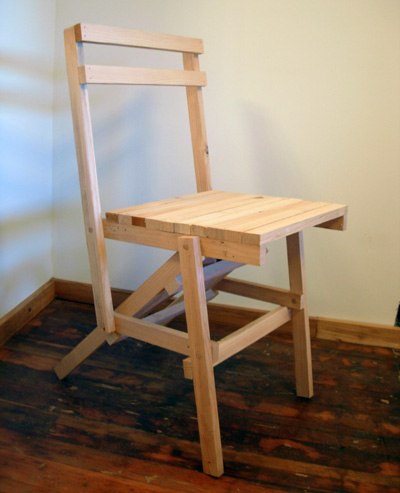
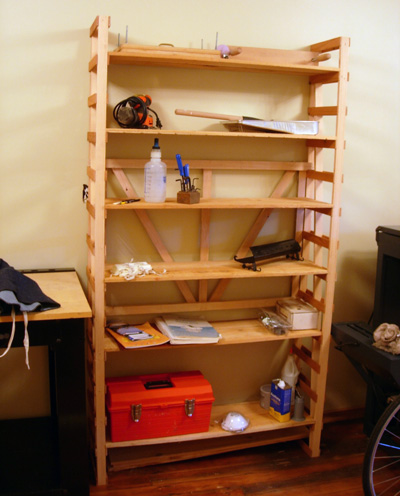
I made a desk, chair, and shelf unit. They're made almost entirely of salvaged fir 1 × 2 that I found at the Rebuilding Center, a fantastic source for reclaimed and deconstructed building supplies here in Portland. So besides being philosophically appropriate, this furniture is cheap. I spent about 30 bucks on lumber, 20 of which went into the non-salvage cedar fence boards that make up the desktop and shelves. It was also fast. Me and Jordan banged the desk together in a couple hours. I made a few adjustments to Mari's designs (which, coincidentally, he considers an integral part of the process of making this furniture). Probably the most blatant was to reinforce the connections in the base of the chair by replacing the prescribed nails with 1/2 inch oak dowels. I was worried about the chair falling apart.


No comments:
Post a Comment